
Denver DBS Center at Neurosurgery One
Deep Brain Stimulation is not a one-doctor procedure. It takes a coordinated team of specialists working together from your first appointment through years of follow-up to provide the easiest patient experience and the best results.
At the Denver DBS Center at Neurosurgery One, we’ve already assembled that team for you. You don’t have to track down the right neurologist, find a neuropsychologist, or wonder who handles your programming after surgery. Every specialist you need is part of our program and accustomed to working together to provide the best outcome for each patient.
Because Neurosurgery One is located immediately adjacent to AdventHealth Littleton, our clinical and surgical teams coordinate daily and meet formally each month in a dedicated DBS conference to review every active case. The result is the kind of integrated, whole-team care that defines the best DBS programs in the country.
Whether you are ready to pursue deep brain stimulation or you're doing research, we're here for you. To learn if you're a candidate and start DBS, schedule a clinic appointment. We can see new patients within a week. If you are looking for more information, schedule a free phone call with our DBS nurse navigator. Either way, we're beside you.
Who Is on Your DBS Team?
Here is a list of the multidisciplinary team members and their role in your care at the Denver DBS Center.
- DBS Nurse Navigator
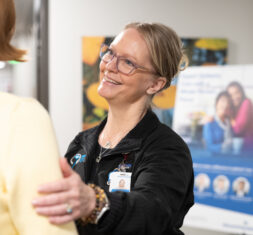 Julie Weitze, our DBS Nurse Navigator, provides a single point of contact for you throughout your entire DBS journey — from the moment you become curious and want to learn more about DBS through your long-term follow-up care. Julie coordinates your appointments, pre-surgical testing, insurance questions, and follow-up scheduling — and checks in on you long after surgery is complete. She is often the first person you’ll speak with and the one you’ll call when questions come up. Meet Your DBS Nurse Navigator.
 - DBS Neurosurgeons
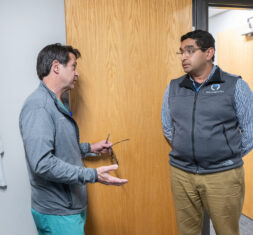 Dr. Abhijeet Gummadavelli, MD, and Dr. David VanSickle, MD, PhD, are our highly experienced DBS surgeons who will lead your surgical planning and perform your surgery. Dr. Gummadavelli specializes in functional neurosurgery, including DBS and epilepsy surgery, and completed fellowship training at Vanderbilt University. Dr. VanSickle, Medical Director of the Denver DBS Center, is a pioneer in asleep DBS technique. Together they have performed more than 1,000 DBS surgeries, with complication rates far below national averages.
 - Advanced Practice Providers (APPs)
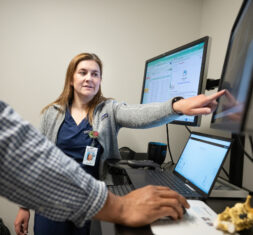
Our physician assistants and nurse practitioners support your care throughout the process by conducting evaluations, managing pre-operative coordination, monitoring your recovery, and serving as an accessible point of contact between visits.
- Movement Disorder Neurologists
Neurologists who specialize in Parkinson’s disease, essential tremor, dystonia, and related conditions are integral to the DBS program. They help confirm DBS candidacy, conduct on/off medication testing, conduct epilepsy studies, and work with our team at the monthly DBS conference to guide programming decisions. We also work closely with your neurologist, ensuring that your personal health history is taken into consideration and your neurologist is ready to take over your care after surgery, if needed.
- DBS Programming Specialists
After surgery, your device needs to be carefully programmed to achieve the best possible symptom control. Our programming specialists have deep experience optimizing DBS parameters for each patient’s unique symptoms and goals, and they are available for remote programming when appropriate.
- Neuropsychology
A neuropsychological evaluation is a standard part of the DBS candidacy process. Our neuropsychologists assess cognitive function to help your surgical team ensure DBS is right for you and to establish a baseline for your long-term care.
- Physical Therapists
Physical therapy supports your recovery and helps maximize the functional gains that DBS makes possible. Our physical therapists work with patients before and after surgery to support mobility, strength, and quality of life.
- Surgical Team — OR Nurses & Scrub Techs
The nurses and scrub technicians in the DBS operating room at AdventHealth Littleton are trained specifically for DBS procedures. This is not a general surgical team doing an occasional DBS case. Their familiarity with the procedure, the equipment, and the workflow contributes directly to the safety and precision of every surgery
- Radiologists
Our radiologists review pre-operative MRI and CT imaging as standard practice and are immediately available for consultation when imaging reveals anything requiring additional attention before or during surgical planning. The proximity of Neurosurgery One to AdventHealth Littleton means there are no gaps or delays in that collaboration.
A Team That Is Here for You
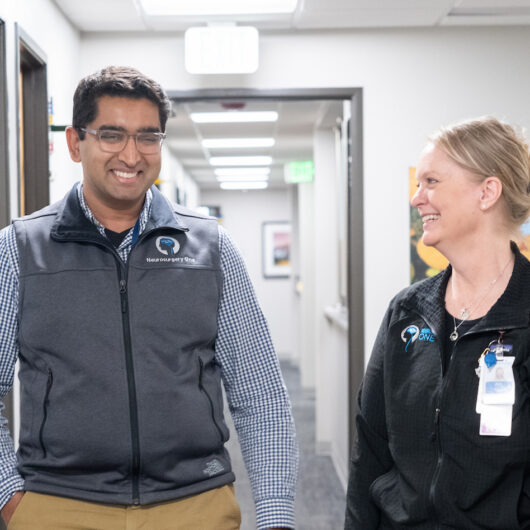 Our team approach extends to some of the most consequential decisions in your care — including whether DBS is right for you at all. For patients with Parkinson’s disease, for example, responsiveness to medication is a key predictor of whether DBS will help. On/off testing, neuropsychological evaluation, and imaging aren’t bureaucratic hurdles. They are the data the full team reviews together to make sure DBS is the right choice for your specific situation — and that you’ll be safer and better off because of it.
For many patients one of the most reassuring things about the Denver DBS Center is that a full DBS multidisciplinary team is already in place. This is particularly helpful for patients travelling from Wyoming, Kansas, Nebraska, New Mexico, or rural Colorado.
At large academic medical centers, patients sometimes find themselves navigating between departments that don’t always communicate. At Neurosurgery One, the DBS team confers daily and meets formally every month to review cases together. Your nurse navigator knows every member of the team personally and can explain each specialist’s role, what to expect from each appointment, and how everything fits into your overall plan.
Questions? Talk to a nurse navigator.
Want to understand what your DBS journey would look like? Start with a conversation with our DBS Nurse Navigator. She can walk you through the team, the timeline, and what to expect.
Frequently Asked Questions About A DBS Care Team
- Who is on a DBS care team?
A complete DBS care team typically includes neurosurgeons, movement disorder neurologists, DBS programming specialists, neuropsychologists, advanced practice providers, physical therapists, and a nurse navigator or care coordinator. The team at the Denver DBS Center includes all these specialists, along with a specialized surgical team at AdventHealth Littleton who are trained specifically for DBS procedures.
- Do I need my own neurologist to get DBS at Neurosurgery One?
No, not if you don’t have one. If you do have a neurologist, our surgeons will coordinate your care with your doctor. If you need neurological support as part of your DBS evaluation or follow-up, our team can assist with that as well.
- What is the role of a DBS nurse navigator?
A DBS nurse navigator is a specially trained registered nurse who coordinates your care from start to finish. At the Denver DBS Center, Julie Weitze serves as the nurse navigator for all DBS patients. She helps schedule appointments and testing, explains each step of the process, answers questions from patients and families, and checks in on you throughout recovery and long-term follow-up. She is often the person patients call first when something feels uncertain.
- How does the Denver DBS team communicate with each other?
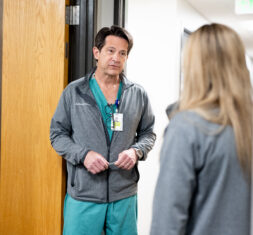
Because Neurosurgery One is located immediately adjacent to AdventHealth Littleton, our clinical and surgical teams are in regular daily contact. In addition, the full DBS team meets monthly in a formal DBS case conference to review every active patient and ensure care is progressing on track. This level of coordination is comparable to what you would find at a major academic medical center but delivered in the more personalized atmosphere of a community hospital.
- Does a DBS program at a community hospital compare to a major academic center?
Yes. In several respects, the patient experience at a dedicated community-based program can even be better. Our surgeons have education and experience equivalent to the country’s top academic programs. The Denver DBS Center performs more than 50 DBS surgeries per year, places leads within 0.85mm of target using robotic guidance and maintains an infection rate below 0.3%, well below the national average of 3%. What patients gain is that expertise delivered in a setting where you are known by name, your calls are returned and your care team is consistent from visit to visit.
- What happens if my imaging shows something unexpected before DBS surgery?
Our radiologists are immediately available for consultation if pre-operative MRI or CT imaging reveals anything requiring additional attention. Because our clinical team is co-located with AdventHealth Littleton, there are no delays in getting a radiologist’s input.
- Can referring neurologists speak directly with the Denver DBS team?
Yes. Referring physicians are welcome to contact our team directly. Our nurse navigator can facilitate communication between your practice and our neurologists and surgeons. Many referring neurologists across Colorado, Wyoming, Kansas, Nebraska, and New Mexico have long-standing relationships with our program and rely on us as their primary DBS referral partner.
- Is the Denver DBS Center team experienced with rare or complex DBS cases?
Yes. While a significant portion of our patients have Parkinson’s disease, the team also works with patients who have essential tremor, dystonia, OCD or epilepsy. Our monthly DBS conference allows the full team to review complex or unusual cases together, and our surgeons bring subspecialty expertise in both functional neurosurgery and neuroengineering to challenging presentations.
For Referring Physicians
The Denver DBS Center welcomes referrals from movement disorder neurologists and general neurologists across the Rocky Mountain region. Our team includes movement disorder neurologists as part of the program, and our nurse navigator works directly with referring offices to streamline the evaluation process for your patients.
Our surgical outcomes — including a revision rate of less than 1% against a published national average exceeding 15%, and an infection rate below 0.3% — reflect the experience and consistency of a high-volume, dedicated DBS program. Submit a referral.
This page was revised and approved on April 20, 2026, by Dr. Abhijeet Gummadavelli, fellowship-trained functional neurosurgeon and DBS specialist with Neurosurgery One.